Computational Physics Portfolio
Tip. Every highlighted link in this page is clickable. For fast navagation use Table of Contents
Nels Buhrley Physics Student — Brigham Young University–Idaho
Table of Contents
- About
- Academic Projects
- Personal Projects
- Selected Results
- The Fulton Supercomputer at BYU
- Quick Start
- Repository Structure
About
I created this repository as a collection of thirteen numerical simulation and computational mathematics projects developed during my physics coursework and independent study. The work spans classical mechanics, electrostatics, statistical mechanics, quantum mechanics and number theory — all implemented in C++17 with Python 3 visualization pipelines.
Core Competencies
| Area | Details |
|---|---|
| Languages | C++17, Python 3 |
| Numerical Methods | Runge-Kutta (RK4), Euler-Cromer, Störmer-Verlet, Monte Carlo (Metropolis), Finite Differences, Successive Over-Relaxation, FFT spectral analysis |
| Parallelism | OpenMP multi-threadin, manual thread allocation, and parrellel logic implimentation in tightly coupled simulations |
| High-Performance Computing | BYU Supercomputer — SLURM batch scheduling with up to 128 CPU cores for intensive simulations (Projects 4, 6, 7) |
| I/O & Visualization | CSV, NPZ (via cnpy/zlib), Matplotlib (3D surfaces, contour maps, animations, phase-space portraits), Plotly (interactive HTML plots) |
| Build Systems | GNU Make with multi-target builds (debug, release, profile-guided optimization) |
Academic Projects
| # | Project | Physical System | Numerical Method | OpenMP | HPC |
|---|---|---|---|---|---|
| 1 | Realistic Projectile Motion | 3D ballistics with drag, spin (Magnus), wind | 4th-order Runge-Kutta | — | — |
| 2 | Driven Damped Oscillations | Nonlinear pendulum → periodic & chaotic regimes | RK4 + Euler-Cromer; Poincaré sections | — | — |
| 3 | Celestial Dynamics | N-body gravitational orbits (full Solar System) | RK4, Euler-Cromer, Störmer-Verlet | — | — |
| 4 | Overrelaxation | 3D Laplace’s equation (electrostatics) | Red-Black SOR with optimal $\omega$ | ✓ | ✓ |
| 5 | Oscillations on a String | Damped stiff wave equation + spectral analysis | Finite differences (2nd + 4th order) + KissFFT | ✓ parallel spatial | — |
| 6 | Diffusion | 3D Brownian random-walk ensemble | Monte Carlo with reflective BCs | ✓ parallel particles | ✓ |
| 7 | The Ising Model | 3D ferromagnetic phase transition | Metropolis MCMC, checkerboard sweep | ✓ multifactor parallel | ✓ 128 CPUs |
| 8 | Molecular Dynamics | 2D Lennard-Jones fluid (400 particles) | Velocity Verlet, O(N²) pair forces | ✓ thread-local accumulators | ✓ 8 CPUs |
| 9 | Quantum Mechanics | 1D Schrödinger equation, symmetric polynomial potentials (even degrees: 2, 4, 6, 8, 10) | Numerov 4th-order integration, nodal bracketing, dual shooting/matching bisection | — | — |
Progression
The projects follow a deliberate arc of increasing computational sophistication:
- Projects 1–3 build fluency with ODE integration (RK4, symplectic methods) and interactive simulations
- Project 4 introduces PDE solving, iterative methods, and OpenMP parallelism
- Projects 5–6 combine PDE/stochastic methods with spectral analysis and 3D particle tracking
- Project 7 synthesizes everything: statistical physics, Monte Carlo methods, precomputed lookup tables, multi-dimensional parameter sweeps, and full HPC deployment
- Project 8 tackles the hardest parallelization challenge — an $O(N^2)$ N-body problem where Newton’s third law optimizations create race conditions, resolved via thread-local accumulators and guided scheduling
- Project 9 applies boundary value problem solvers to quantum mechanics: energy quantization through nodal counting, high-order Numerov schemes, and dual-method bisection convergence (shooting via forward integration from origin; matching via backward integration with origin-centric boundary matching)
Personal Projects
| # | Project | Domain | Key Challenge | Parallelism |
|---|---|---|---|---|
| 1 | Collatz Conjecture (3n+1) | Number theory | Exhaustive sequence analysis for $n \leq 10^6$; recursive max-value chaining | — |
| 2 | Euler’s Idoneal Numbers | Number theory | Sieve over triple loop $a < b < c$ up to $5 \times 10^7$; thread-safe monotonic writes | ✓ OpenMP dynamic |
| 3 | Monty Hall Problem | Probability & Statistics | Monte Carlo simulation to empirically verify counterintuitive theoretical predictions | — |
Selected Results
Project 7: The Ising Model
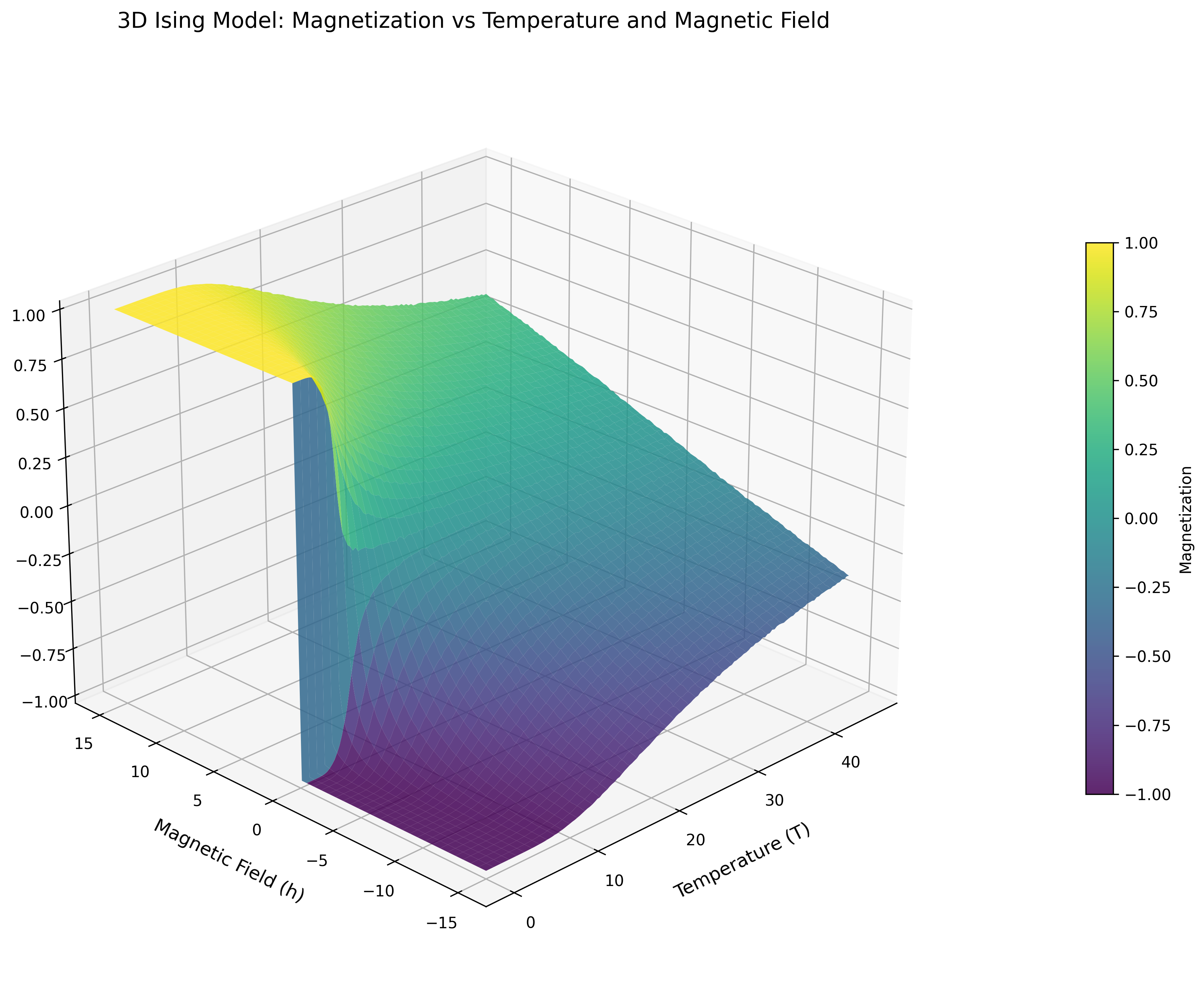
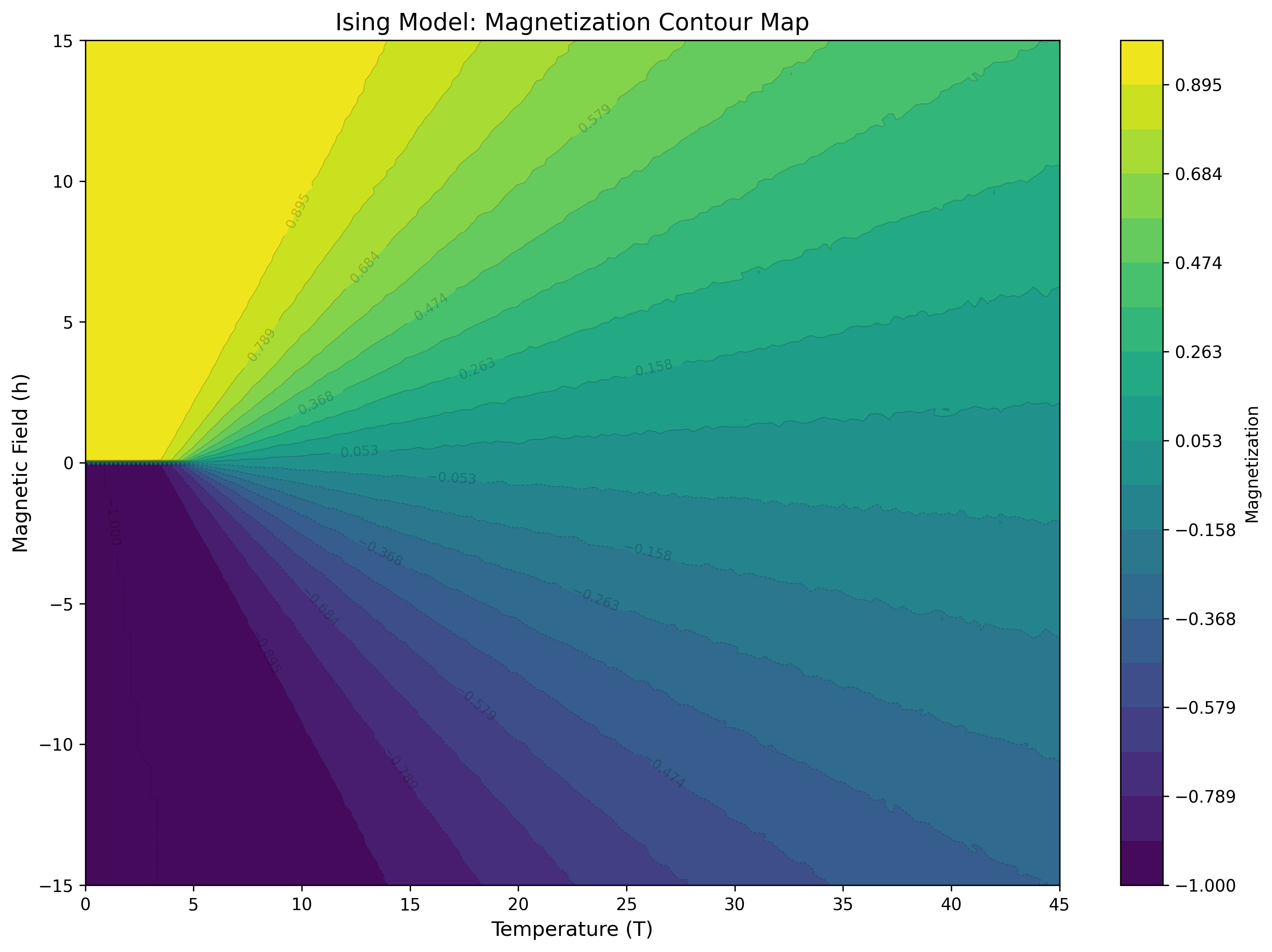
Magnetization surface and contour map of the 3D Ising model, revealing the ferromagnetic phase transition at $T_c \approx 4.51\,J/k_B$. Monte Carlo Metropolis algorithm with checkerboard sweep optimization across 2D temperature × magnetic field parameter space.
Project 8: Molecular Dynamics
Heating/cooling cycle simulation of 400 particles under Lennard-Jones potential. Particle trajectories show transition from ordered grid to gas-like disorder during heating, then re-ordering during cooling. A shock wave propagates down from the top and reflects back up after the particles expand to the container boundary.
Project 4: Overrelaxation (Electrostatics)
Interactive 3D visualization of electrostatic potential field solved via Successive Over-Relaxation (SOR) with optimal relaxation parameter $\omega \approx 1.84$. Navigate through z-axis slices to explore the full 3D solution space ($N=1000^3$ grid points).
Project 3: Celestial Dynamics
videos/
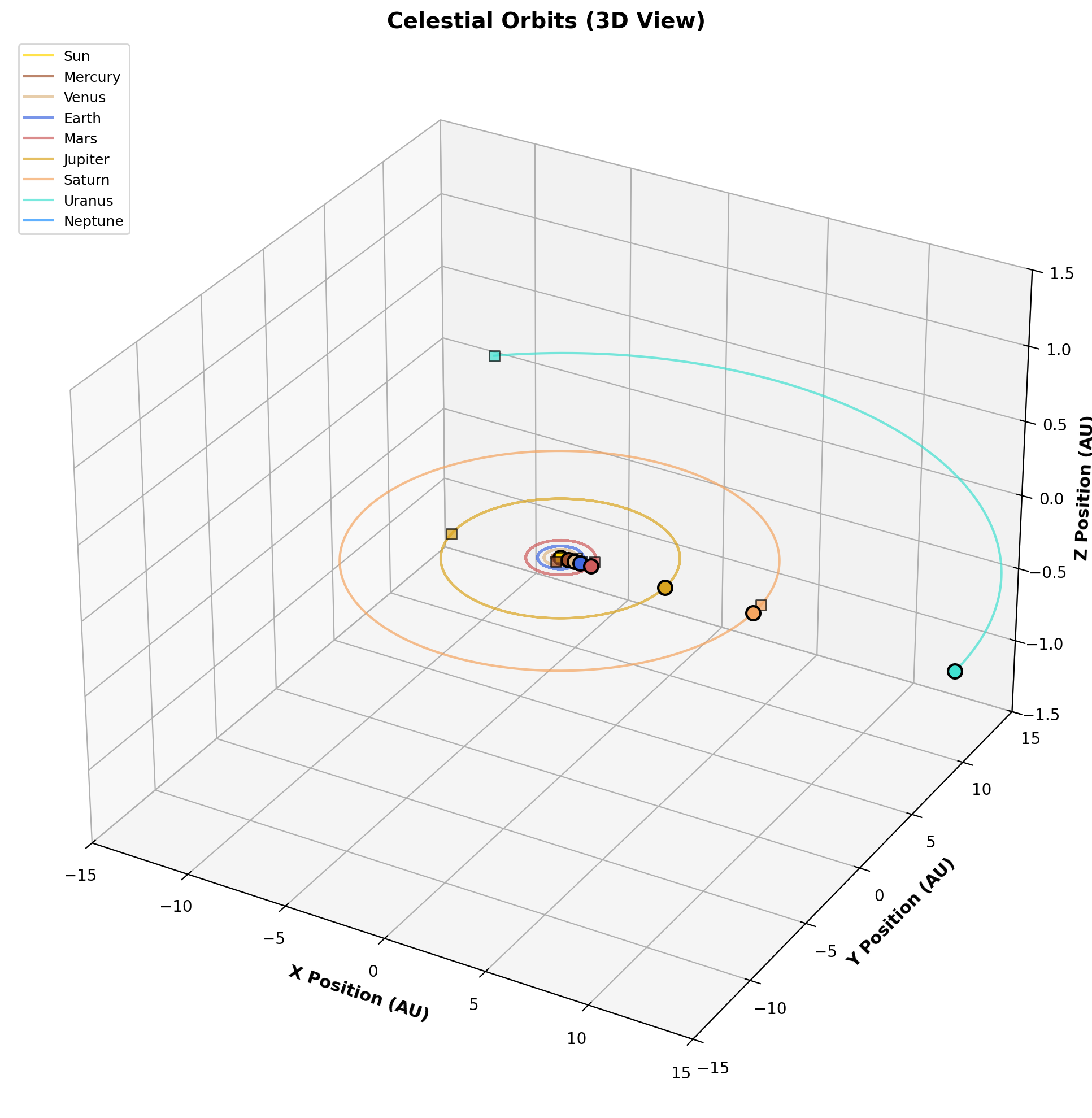
N-body orbital dynamics of the Solar System computed with 4th-order Runge-Kutta integration. Left: Static plot of solar system. Right: Video of the solar system with the mass of Jupeter equil to about 0.94 Solar Masses.
Project 9: Quantum Mechanics
View Eigenstates Fullscreen ↗️
Interactive visualization of bound states for symmetric polynomial potential wells (even degrees: 2, 4, 6, 8, 10). Each tab displays eigenstates with 3D wavefunction plots overlaid with the potential well shape. Eigenstates computed via Numerov 4th-order integration, energy quantization by nodal counting, and dual-method bisection refinement (selectable shooting method with forward integration or matching method with origin-centric convergence) achieving high precision ($\Delta E < 10^{-8}$).
Project 5: Oscillations on a String
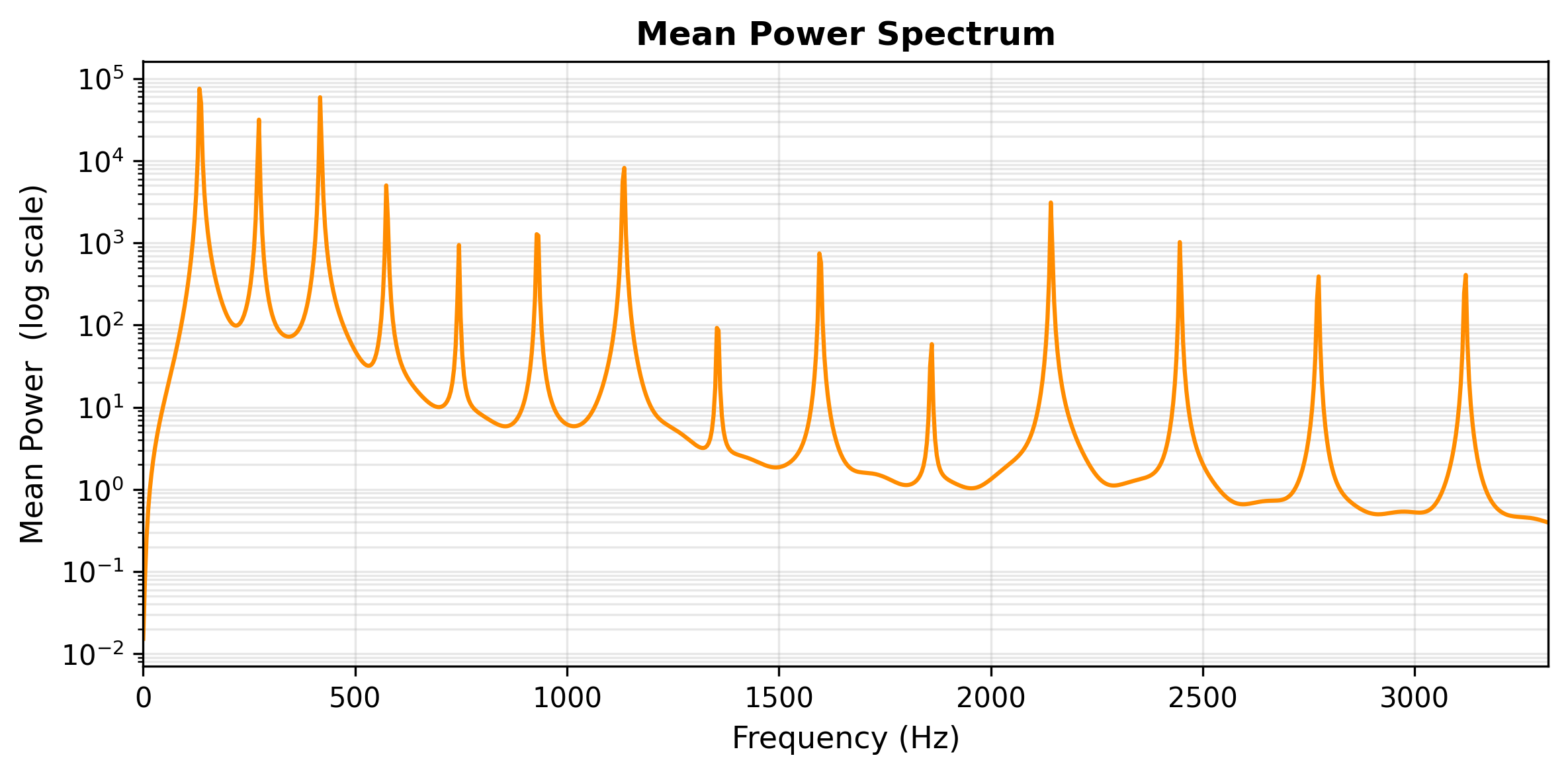
Mean power spectrum of transverse string oscillations showing discrete normal-mode peaks. FFT spectral analysis reveals harmonic structure and damping characteristics from finite-difference wave equation solver.
Project 6: Diffusion
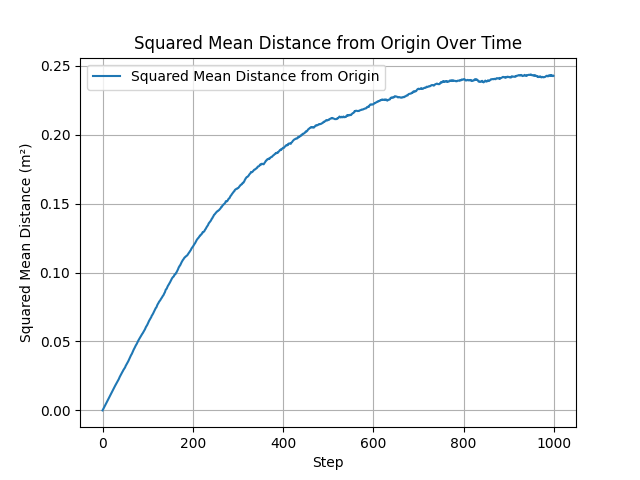
Mean squared displacement from 3D random-walk Monte Carlo simulation, confirming Einstein’s diffusion law $\langle r^2 \rangle = 6Dt$. Ensemble of $10^6$ particle trajectories with reflective boundary conditions.
The Fulton Supercomputer at BYU
|
The Fulton Supercomputer (managed by the BYU Office of Research Computing) is a HPC cluster providing the processing backbone for my numerical modeling and simulation work. It manages over 35,000 CPU cores and 360+ GPUs, supported by a 6 PB parallel filesystem.
Architecture & Resources (2026 Specs):
|
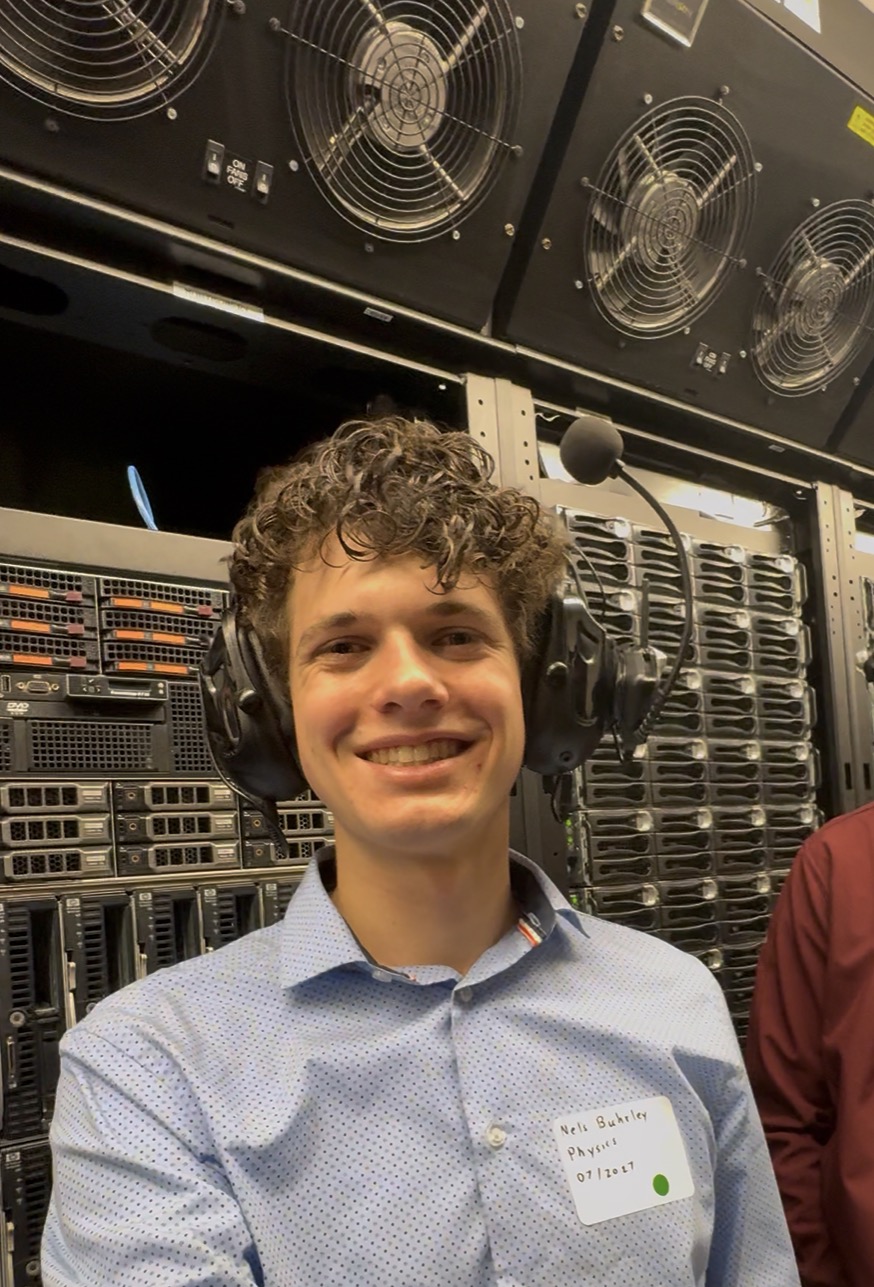
Me at the BYU HPC cluster, February 2026 |
Workflow & Scheduling
Job Management
I utilize SLURM (Simple Linux Utility for Resource Management) to orchestrate simulations. This involves writing batch scripts that request specific hardware constraints to optimize performance, such as:
--constraint=avx512for vector instructions.--qos=standbyfor acess to unused priviate hardware.
Environment & Compilation
Development is performed on RHEL 9.4 login nodes using Remote - SSH and the linux terminal to manage my development and computational resources. I manage software dependencies via the module load system, typically involving:
- GCC/G++ for core simulation logic.
- OpenMPI for distributed memory parallelism.
- Python 3/ffmpeg for visiulation
Physics Implementation
On this cluster, I implement numerical solvers for complex potentials where the computation scales as $O(N^{2+})$. For a system of $N$ particles, the potential $V$ is calculated as:
\[V = \sum_{i < j} \frac{q_i q_j}{4\pi\epsilon_0 |\mathbf{r}_i - \mathbf{r}_j|}\]By utilizing OpenMP for multi-threading and MPI for node-to-node communication, I can distribute these calculations, significantly reducing the wall-time required for high-resolution datasets.
// Example: Basic OpenMP Parallelization for Force Calculation
#pragma omp parallel for reduction(+:total_energy)
for (int i = 0; i < N; ++i) {
    for (int j = i + 1; j < N; ++j) {
        total_energy += calculate_interaction(particles[i], particles[j]);
    }
}
Simulation Deployment (This Portfolio):
| Project | Configuration | CPUs | Wall Time | Use Case |
|---|---|---|---|---|
| Project 4 (SOR) | CPU-only, #threads=16 |
16 | 30–45 min | Strong-scaling study of iterative PDE solver |
| Project 6 (Diffusion) | CPU-only, #threads=32 |
32 | 2-3 min | Parallelizing independent particle trajectories |
| Project 7 (Ising) | CPU-only, #threads=128 |
128 | 10–45 min | Large parameter-space sweep with checkerboard MCMC |
| Project 8 (Molecular Dynamics) | CPU-only, #threads=8 |
8 | 10 min–2 hrs | Thread-local force accumulation (race condition mitigation) |
Key Advantages for This Work:
- Scalability Testing: Weak and strong scaling studies for OpenMP efficiency (Projects 4, 7, 8)
- Parameter Sweeps: Multi-dimensional search spaces (Project 7: 2D temperature × field grid)
- Long-Running Simulations: Statistical ensembles (Project 6: millions of particle trajectories)
- Reproducibility: Identical hardware across multiple runs for benchmarking and verification
Quick Start
Every project follows the same workflow:
# 1. Navigate to a project
cd "Project 7: The Ising Model"

# 2. Build
make release

# 3. Run
./bin/main

# 4. Visualize
python3 plotting.py
Build Toolchain
| Tool | Version | Notes |
|---|---|---|
| Compiler | clang++ / g++ (C++17) |
Platform-detecting Makefiles |
| OpenMP | Homebrew libomp (macOS) / native (Linux) |
Projects 4–7 |
| zlib | System | For .npz output via cnpy |
| Python | 3.x | numpy, matplotlib, pandas |
| SLURM | BYU Supercomputer | Batch scheduling for HPC runs |
Prerequisites
# macOS
brew install libomp
pip3 install numpy matplotlib pandas

# Linux (e.g., BYU Supercomputer)
module load gcc python   # or equivalent
pip3 install numpy matplotlib pandas
Repository Structure
CPP_Workspace/
|-- README.md                          # <- This file (Portfolio Hub)
|
|-- Project 1: realistic projectile motion/    # RK4 ballistics with drag & Magnus
|-- Project 2: driven damped oscillations/     # Nonlinear pendulum & chaos
|-- Project 3: Celestial Dynamics/             # N-body gravitational simulation
|-- Project 4: Overrelaxation/                 # 3D Laplace solver (SOR + OpenMP)
|-- Project 5: Occilations on a string/        # Wave equation FD + FFT spectral
|-- Project 6: Diffusion/                      # 3D random-walk Monte Carlo
|-- Project 7: The Ising Model/                # 3D Metropolis MCMC (HPC)
|
|-- Personal Project 1: 3n+1/                 # Collatz conjecture exploration
|-- Personal Project 2: Idelic Numbers/        # Euler's idoneal number sieve
|
|-- include/                                   # Shared libraries
|   |-- cnpy.h                                 # NPZ I/O library
|   `-- vector3d.h                             # 3D vector utilities
|-- src/
|   `-- cnpy.cpp                               # cnpy implementation
|
|-- reference/                                 # Study notes & cheatsheets
|   |-- CPP_BASICS.md
|   |-- FUNCTIONS_REFERENCE.md
|   |-- NUMERICAL_PHYSICS.md
|   |-- OPTIMIZATION_TIPS.md
|   `-- SLURM_FORMATING.md
|
`-- Template Makefile                          # Reusable build template
Nels Buhrley — BYU-Idaho Physics, 2025–2026